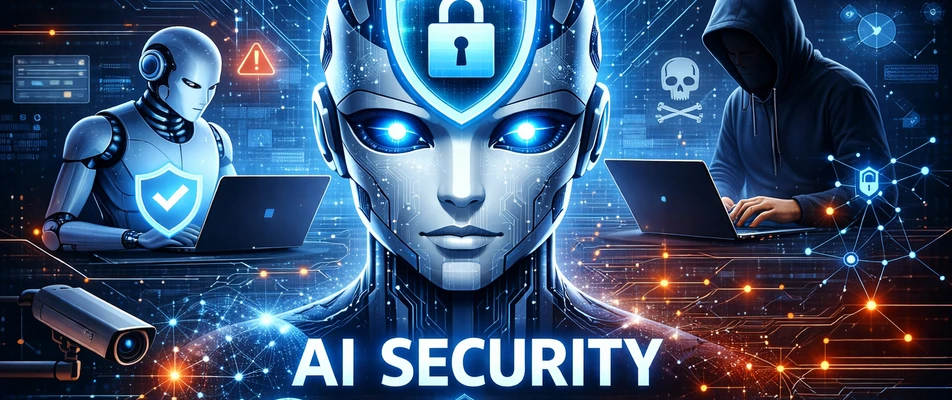
"AI is like fire. Good servant, bad master."
Artificial intelligence is now part of almost every profession – and if we can use it properly, it can be of great help to us. We spoke to Libor Sedláček, an HR analyst at MND who has been actively using AI for several years, about his day-to-day experiences.
Libor, could you introduce yourself to our readers?
Yes, I’d be happy to. I’ve been working at MND for a year as an HR analyst. My responsibilities include data management, report generation, process analysis, administration of the HR information system, and project management for the implementation of various digital tools. I’m married, and we have two little rascals at home — Viktor, who’s three and a half, and Elenka, who’s just under ten months old. So all my free time is currently spent with the family. Nursery in the morning, the children in the afternoon, and then in the evening I sit down for a bit to watch a series or catch up on some work. Weather permitting, I head out onto the cycle paths. I believe that in the future I’ll return to drumming and also to another of my interests, history.
How long have you been working with artificial intelligence?
Actively for about two to two and a half years. I started out at an IT firm in Brno, where AI was a standard part of software development. Anyone who didn’t use it was at a disadvantage.
What tools do you use today?
Mostly Microsoft Copilot. And the paid version, because it’s faster, more accurate, and, above all, integrated with the entire MS Office ecosystem – OneDrive, SharePoint, Teams, Outlook, Word, Excel… It can access specific documents, understands the context, and responds accordingly. That makes a huge difference.
In which tasks does AI help you the most?
Most often as a personal consultant – when I don’t know how to do something. Whether it’s functions in Excel, Power Automate settings, a complex script or a report structure design. It’s as if I had a consultant colleague sitting next to me, advising me in real time.
Can you give a specific example of how you use AI?
Certainly. I created a bot that sends birthday wishes to colleagues. Previously, an HR specialist did this manually — every day they had to check the system, prepare the wishes and send them out. It took about half an hour a day. Now a robot does the same thing: it recognises who’s having a birthday, sends the card in real time, handles weekends and public holidays, and makes no mistakes.
How much time did you save?
About two hours a week just here. And at another company in the group, it saved four days a month. Colleagues were thrilled.
How long did it take to build the bot?
Two days of pure development time. And a lot of brainstorming with Copilot. At one point I thought to myself: “Blimey, I’m communicating exactly as if I were messaging a programmer or a consultant.” That was my big ‘aha’ moment.
Have you had any failures?
Yes, a big one. It was about two years ago, right when I was starting out with AI. I was trying to use AI to create a set of organisational rules. Because the brief was too vague, Copilot started suggesting nonsense. It returned the first document it found. As soon as I started editing and changing it, we got stuck and it went nowhere. In the end, I stopped the process completely.
What did you take away from that?
AI needs a specific prompt. If you tell it “Create an organisational chart”, it’ll give you anything. If you break it down into small steps — “Create a structure”, “Suggest roles”, “Describe responsibilities” — then it works. It’s like a personal assistant. If you give it the wrong prompt, it’ll give you the wrong result.
Has AI improved the quality or speed of your work?
Definitely. Copilot helps me produce higher-quality and more accurate outputs and significantly speeds up my work with data. I notice this most in Excel, where I use it for more complex functions that aren’t commonly used, when creating macros, or when working with Power Query, which can clean and edit large amounts of data. Copilot also helps me create scripts or algorithms that allow Excel to perform certain steps automatically — for example, loading data, editing it, recalculating outputs or creating charts. Thanks to this, I can create templates that I then reuse, rather than doing everything manually from scratch. I then devote the time saved to the actual analytical work or further learning, which is far more valuable.
How do you verify the accuracy of the outputs?
It’s important to note that I only use AI for drafting concepts, never for the final output. For technical matters, I check whether the script actually runs and produces the correct result. For text analysis or concept development, I use a three-point system:
- I compare the number of chapters,
- I check the chapter titles,
- I randomly select two or three sections and compare them with the original.
If everything matches, I consider the output to be valid. The key to using AI correctly is to think critically about the output. If something doesn’t sit right with me, I ask for clarification and verify it. My verification process is always tailored to what I need from the AI at that moment.
How do you handle the protection of sensitive data?
I use the company’s paid version of Copilot, which complies with internal security rules. And I never enter anything there that doesn’t belong. The principle is simple: AI helps, but the responsibility lies with the person.
Do you share your experiences with colleagues?
Yes, we do — both within our HR team and at various meetings across the whole group. When I introduced the birthday generator, it was a huge success. It’s nice to see that something you create can actually help others.
What else would you like to try out or improve in your work with AI?
Definitely more advanced automation. I’d also like to work more with predictive analytics, and I’d like to get more involved with communication platforms and the integration of digital assistants into the organisational structure. And above all, to share experiences across the company. The more we use AI, the more it will give back to us.
Do you have a message for our readers?
Yes. Don’t be afraid of AI. It’s a tool that’s already here and is here to stay. It can save us time, stress and routine tasks. But what I once heard still holds true: “AI is like fire. A good servant, a bad master. Whoever learns to use it will win.”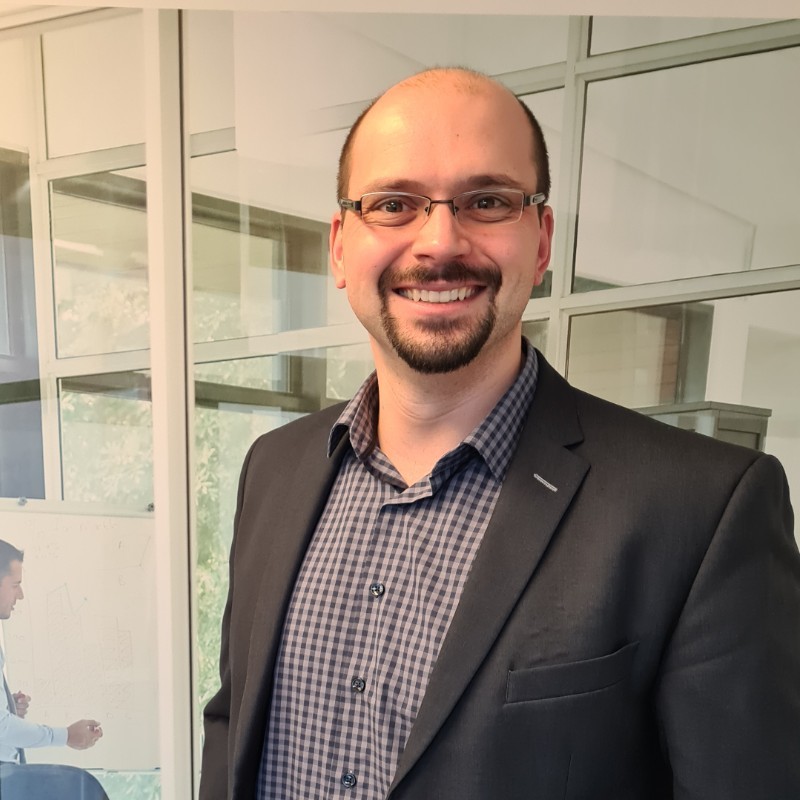
| “Stories like Libor’s are important to us. They show that when someone has a clear goal and knows how to use AI as a tool, they can simplify their own work and that of their colleagues — without a complex project and without waiting for a centralised solution. Our role in IT is to support such use: to provide secure tools, rules and conditions. The fact that Libor uses the paid version of Copilot within company guidelines and verifies the results is exactly the responsible approach we want. AI should be a smart servant — and for that we need both the technology and the people who know how to use it.” Zdeněk Král, Head of the System Operations Centre |
Internal and External Communications Manager
Other articles
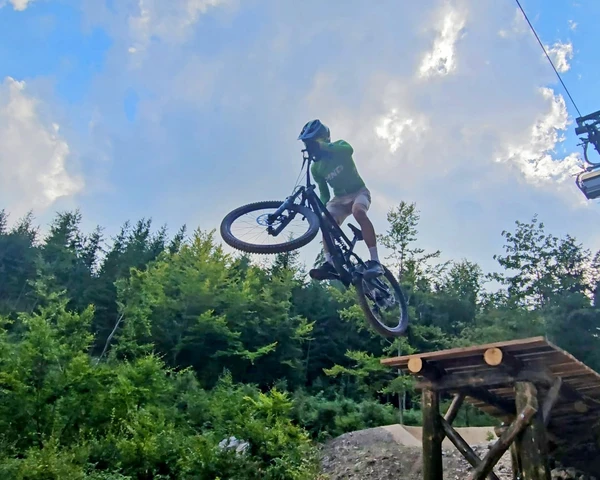
Martina Kadavá is the winner of the cycling-photo-contest!
Our cycling-photo-contest knows its winner. Martina Kadavá won the most votes with her photo of her son, who had a blast in the MND bike park. And what does she get for winning? Another MND cyclo-dress! :)
For the first time, we have published a sustainability report. Why is it important?
It has been impossible to escape the topic of ESG in recent years. We have written about it several times in our magazine and spoken to many of you. In May this year, we put theory into practice and published the first consolidated sustainability report for the MND Group under the new European rules. This is not just a task or an obligation. Above all, it is clearly compiled data on how our Group operates from a different perspective - ecological, human and process. In this article, you will briefly learn what we reported, what we found out about the Group as a result and what the sustainability report means in practice.
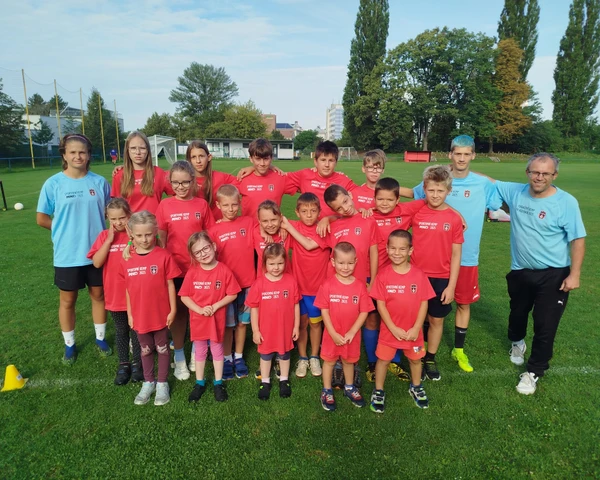
Moving children: Suburban camps with our partners
This year we prepared two dates of suburban camps for the children of our employees during the summer holidays. The first camp took place at the beginning of July in cooperation with Handball Hodonín, the second one at the end of the summer in cooperation with FK Hodonín.