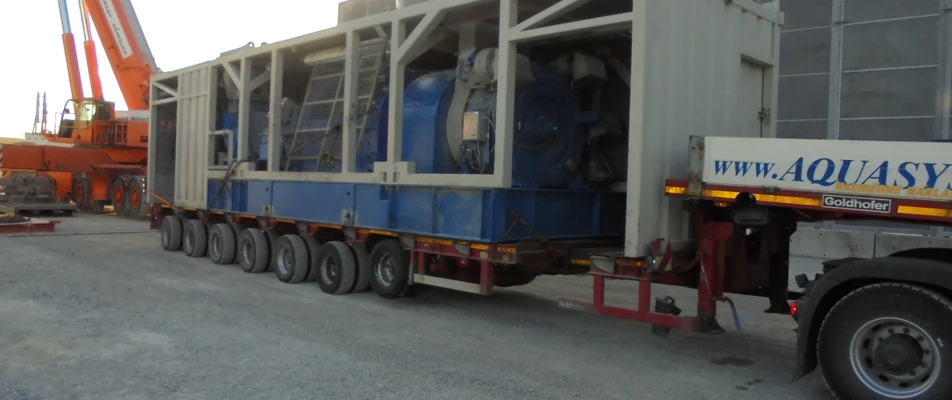
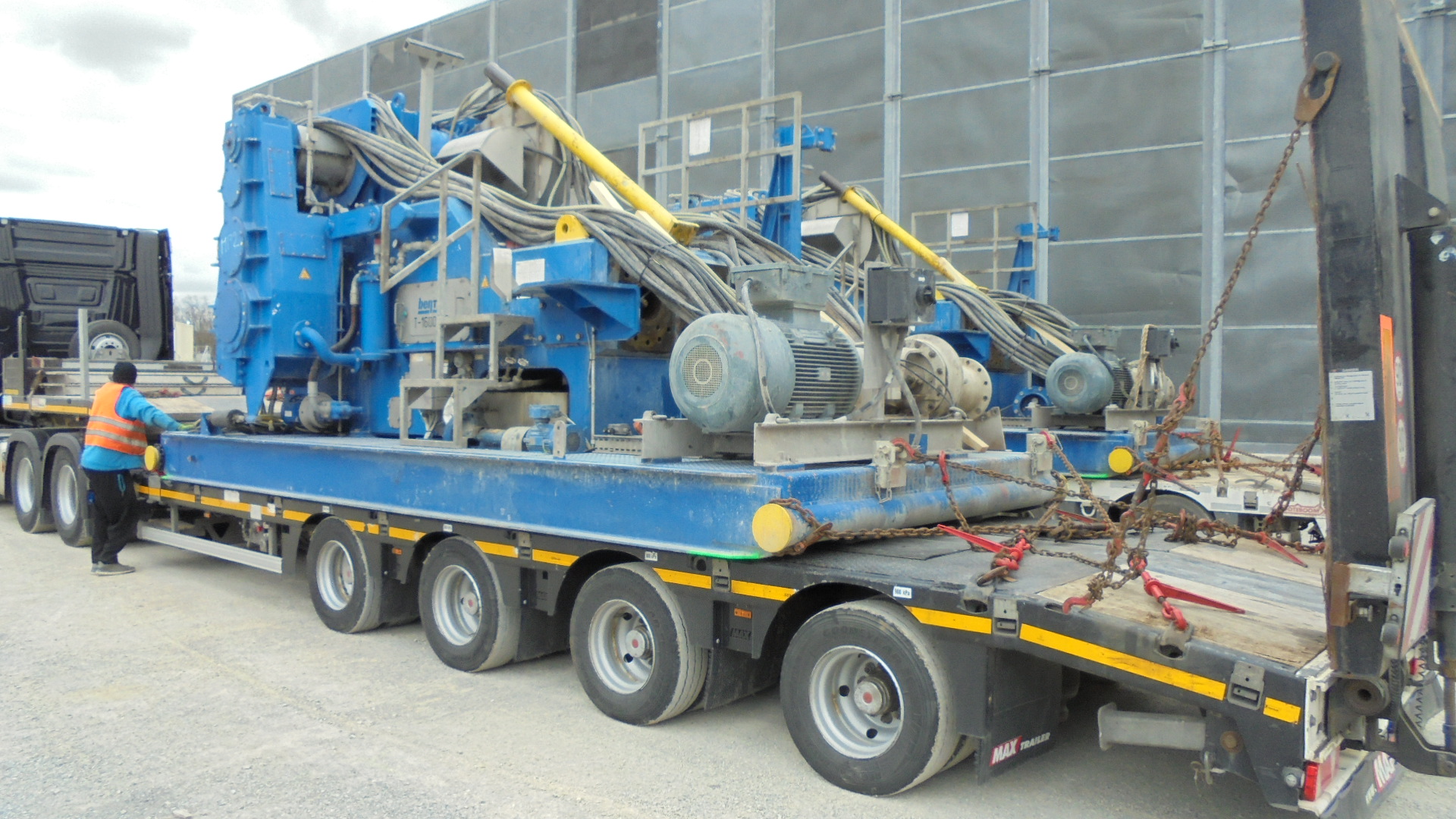
How are heavy goods vehicles transported across Europe?
From the perspective of transporting our drilling rigs, 2025 was once again a period of intense activity, meticulous planning and complex logistics. Our fleet of Bentec 250, Bentec 350, Bentec 450 and MD150 rigs was moved between a number of destinations across the whole of Europe during the year. Each such move is a complex operation requiring an experienced team, detailed coordination and a high level of technical preparedness.
What does moving a single rig entail?
Transporting a drilling rig is not a one-off affair. Each rig is divided into dozens of separate loads, which must be transported individually:
Bentec 250
: 77 consignments
; Bentec 350
: 80 consignments
; Bentec 450
: 85 consignments
; MD150
: the rig itself travels under its own power (50 consignments)
Each load has its own specific characteristics – ranging from standard containers to oversized and over-limit items, which require permits for special use of public roads, escort vehicles or special route planning. Oversized or over-dimensional loads account for almost half of the total number of loads for each convoy.
Individual components are handled using cranes with lifting capacities ranging from 80 tonnes to 450 tonnes. The choice of suitable equipment depends not only on the dimensions and weight of the individual components, but also on the height of the convoy and the spatial constraints of the specific worksite.
The heaviest and largest parts transported:
The most challenging items regularly include the main structural components of the rigs; by way of example, these include the following:
mud pumps – weighing up to 45 tonnes
rig floor sections – weighing between 30 and 46 tonnes, 13 m long and over 3 m
high (drawworks) B450 – one of the heaviest individual items, weighing up to 65 tonnes
VFD container – with a length of almost 17 m
These components present a logistical challenge not only due to their weight but also their dimensions. Transporting them requires detailed route planning and, in some cases, temporary traffic restrictions.
Destinations and distances
In 2025, our convoys were deployed not only in the Czech Republic but also in several key European regions:
• Germany•
Hungary•
Slovakia•
France
The longest single journey exceeded 1,600 km and involved the complete transport of a train set, including all accessories, from the company’s headquarters in Lužice to the Vauvert site in France (the KEM ONE project).
Efficiency and planning
The key to success lies in optimising transport processes:
• maximising the capacity utilisation of individual journeys•
minimising empty runs•
precise coordination of loading and unloading
This helps to reduce not only costs but also the environmental impact.
The people behind the logistics
Behind every successful transport operation is a team of experienced specialists – drilling foremen, haulage coordinators, drivers and technicians. Their work often takes place in challenging conditions, under time pressure and with a focus on maximum safety.
The transport of drilling rigs is a complex process that combines technology, logistics and experience. The year 2025 confirmed that, thanks to the professionalism of our staff and high-quality planning, we are able to handle even the most demanding projects.
Pavla Fronková
, Head of the Transport Department, MND DS
Other articles
Heat for Košice from deep underground is within reach
Three boreholes up to 3.6 kilometres deep, positive results and a satisfied client. MND Drilling and Services has successfully completed a geothermal drilling project for Košice, which will supply heat to around a fifth of the population of Slovakia’s second-largest city. The client was Geoterm Košice, in which the Slovak state holds a majority stake.
Women in MND: Energy that takes many forms
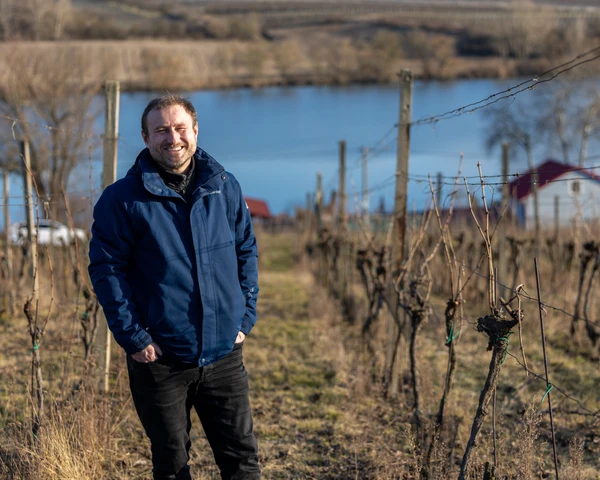
He proposed. And he got a vineyard to go with it.
If you’d met Ondřej Zháněl when he was eighteen and told him he’d one day become a winemaker, he’d probably have tapped his forehead in disbelief. The son of an artistic blacksmith, growing up in Břeclav, he had a field behind his house where, at most, beetroot and potatoes were grown. Wine? That certainly didn’t feature in his plans back then.