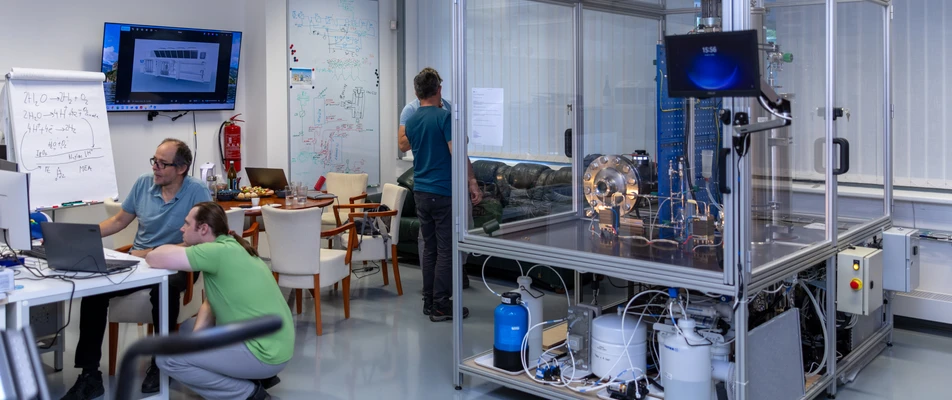
MND aim to lead the way in hydrogen technology
MND, a. s., Energy Division, has made a capital contribution to Nano Advanced, s. r. o. This is another significant step in the development of hydrogen technologies. MND was the first commercial producer of green hydrogen in the country, and MND Gas Storage is preparing for the possibility of storing a mixture of hydrogen and natural gas. Further hydrogen technology projects will require the acquisition of electrolyzers with power input up to 1 MW. Unfortunately, the delivery time for suitable electrolysers is three to five years due to the complexity of their production, and for this reason a capital entry into a company that would produce the equipment in priority for our company and adapt it to our needs seems to be a more interesting option.
Nano Advanced is a start-up active since 2019, whose main focus is the development and production of industrial electrolyzers for hydrogen production. These electrolyzers use a technology called PEM (Proton Exchange Membrane) electrolysis, which allows dynamic power change. For this reason, they will also be usable as SVR (power balance service) providers. The modular concept will allow for easy scalability of power in the range of 0.2-1 MW. This size of electrolyzer, together with the fact that PEM electrolyzers produce high purity hydrogen, predestines the final device for smaller applications such as urban transport companies, freezers, small food and chemical production, etc. The project includes the development of a scalable power source that will allow variable loading of individual segments of the entire system to maximize the efficiency of the conversion of electricity to hydrogen. The load on the individual segments of the system will be controlled by artificial intelligence, which should keep unwanted losses to a minimum and extend the lifetime of the entire electrolyser. All of the above advantages of the chosen concept should enable the cost of the hydrogen produced to be minimised. At present, hydrogen produced by electrolysis is significantly more expensive than hydrogen produced from fossil fuels. There are various ways to reduce its price, e.g. reducing unwanted losses or using low or negative electricity prices in the provision of SVR. It is the use of artificial intelligence that will be a key advantage in the provision of SVR compared to the approaches commonly used today.
The company has ambitions to produce and certify a fully functional prototype within two years. Subsequent mass production should help to make more efficient use of the Lusatian site. The anticipated users of these electrolysers will include not only MND, which will apply them in hydrogen transport and storage projects, but also a number of other companies around the world that will require equipment with the required parameters. The synergy with Nano Advanced should thus help MND to establish itself as a significant player in the field of hydrogen technology, in pursuit of its ESG strategy and to create a further line of business.
Joining Nano Advanced is the first step in MND's journey to become a recognized player in the hydrogen technology field. The opposite approach, where we initially develop the whole device and gradually plan to retrofit and start producing individual components, is illogical at first sight. Incumbent manufacturers such as NEL, Siemens, Hydrogenics and others developed the individual components first and built the whole system from the bottom up. Unfortunately, this traditional approach is very costly in terms of time and money, but ten years ago it was the only possible approach. Today, there are a number of suppliers of individual components that offer customisation to meet customer needs, and therefore a 'build from the top' approach could be taken. The motivation for wanting to gradually start producing these components ourselves in the future is both cost savings and increased control over the production process, and the desire to minimise unwanted influences in the supply chain logistics. A major advantage of the chosen approach is that the electrolyzers sold will generate a profit that can be used to finance the next phases of the project without the need for external financing. After the successful certification of our own electrolyzer and the start of its mass production, we would like to proceed with the development of our own bundles in which the electrolytic reaction of water decomposition into hydrogen and oxygen takes place. First we would like to develop bundles using PEM technology, in the next step we plan to develop our own bundles using AEM technology. We have used AEM technology on a pilot unit at Mikulov 5. The advantage of this technology is significantly lower cost compared to PEM. The technology has operational shortcomings so far, but these should gradually be eliminated as a number of research facilities around the world are working on them. For the time being, a very distant vision is to produce our own catalysts and membranes. If we were able to implement the entire programme, which is a matter of about ten years, MND would be among the world's leading companies controlling all critical steps in the production chain. As we are in talks with leading membrane experts who are interested in collaborating to put their development findings into practice, this is not an impossible vision.
In parallel with MND's electrolyzer construction activities, a pilot underground hydrogen storage facility will be developed to provide seasonal energy storage. Here we would like to test the electrolysers to get as much information as possible from operation.
Key people in the project:
Mgr. Jakub Drnec Ph.D.
D., Ph.D., graduated from the Faculty of Mathematics and Physics, Charles University, majoring in physics. He continued his studies at the University of Victoria, so I would give the University of Victoria in the Canadian province of British Columbia, in the field of electrochemistry and catalyst surfaces for hydrogen fuel cells. That's also where he defended his PhD thesis in 2010. He is currently working as a senior researcher at the European Synchrotron Radiation Facility in Grenoble, France. His main research focuses on materials and technologies for electrochemical energy conversion and storage (generators for hydrogen andCO2, fuel cells or batteries for transport and stationary applications) as well as the use of artificial intelligence for data processing and analysis. Jakub has published over 100 papers in reputed scientific journals (H-factor 33) and is an active member of several organizations in the field of electrochemistry and hydrogen technology.
In his position as Chief Technology Officer at MND, he is responsible for the development of the technology and can therefore take full advantage of his expertise in hydrogen conversion and the development of artificial intelligence tools.
Ing. Jakub Mališ, Ph.D.
He graduated in basic and special inorganic technologies at the Faculty of Chemical Technology of the University of Chemical Technology in Prague. In 2012-2013 he worked at the Norwegian University of Science and Technology (NTNU) in Trondheim, Norway. From 2013-2022 he worked as a researcher at the University of Chemical Technology in Prague, where he was involved in the development of autonomous fuel cell power sources, hydrogen refuelling stations, hydrogen vehicles, fuel cell bundles and new types of catalysts. He has worked with a number of universities and private companies. He has been with MND, Inc. since 2022, where he focuses on the introduction of hydrogen technologies within the group.
Ing. Pavel Srbecký
At Nano Advanced, he acts as CEO, responsible for strategy, complete operations, economics, business and resource management. In this, he draws on the accumulation of knowledge and individual expertise from the operations of other companies, particularly in the areas of biogas and biomethane plants, as well as knowledge of the management of the associated production plants and the operation of start-up companies.
Mgr. Zuzana Kačerovská
In NANO Advanced she is responsible for administration, working with company and project documentation, communication with suppliers and partners. She takes care of the smooth operation of the office, laboratory and other supporting processes, supervises compliance with the company's internal rules and the fulfilment of the set strategic goals.
Other articles
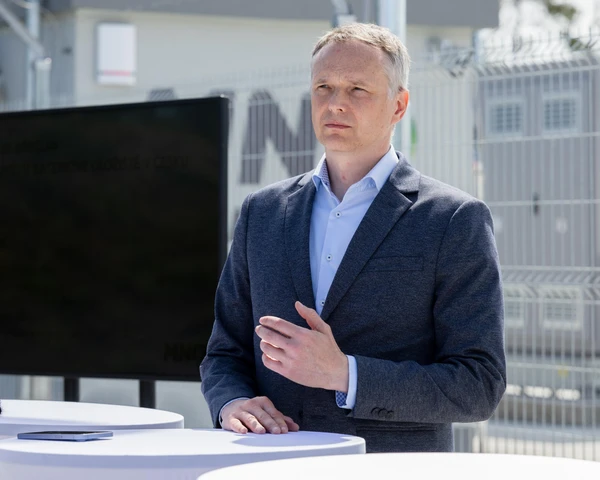
Both the state and customers will benefit from battery storage, says Martin Pich
Battery storage is rapidly becoming a key component of the modern energy sector. It is not just about the technology, but also a new way of generating revenue from flexibility whilst stabilising the grid. Martin Pich, Director of the Trading Division at MND, explains exactly how this business works in practice.
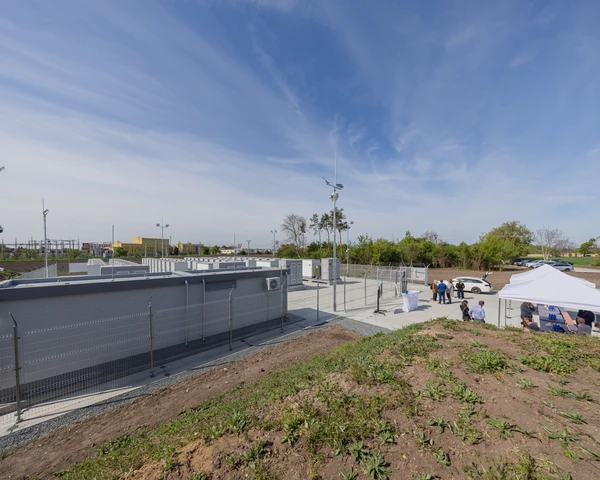
MND is entering the battery energy sector
MND is expanding its activities into a new energy sector – and doing so in grand style. In Břeclav, it has commissioned a 31 MWh battery storage facility, which is currently the largest stand-alone facility of its kind in the Czech Republic. The project, costing around a quarter of a billion crowns, is intended to help stabilise the electricity grid and further develop the electricity trading market.
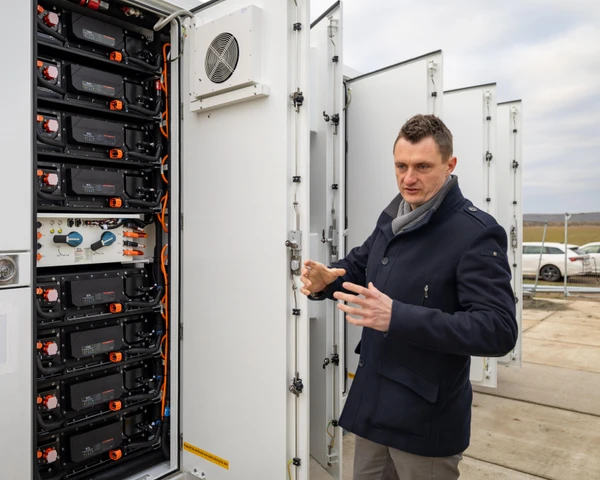
"Batteries are now an opportunity. Whoever builds them fast will seize it."
The MND Group is completing preparations for its first large battery storage facility, BESS Břeclav, with a capacity of 12 MW. When it goes into operation, it will be the largest stand-alone battery project in the Czech Republic and one of the most important milestones in MND's new energy strategy. We spoke with Roman Kroutil, project manager from the New Business Development team, about how the storage facility will work, why now is the ideal time to invest in batteries, and how he got into this field himself.