The conflict in Iran and its impact on energy markets and prices
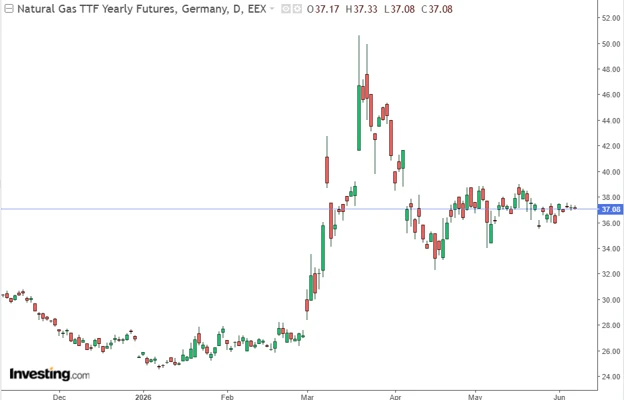
The market entered 2026 on a very optimistic note. Individual liquefied natural gas export projects were proceeding according to plan, and the forward market was pricing in a very healthy supply of gas, meaning prices remained low. The same was true for electricity and oil. But then came the turn of February and March, and everything suddenly changed.
The blockade of the Strait of Hormuz, through which 20–30 per cent of the world’s trade in oil, petroleum products and gas flows, marked a fundamental shift in supply and demand and in prices. Figures 1 and 2 show the price trends for gas for delivery in 2027 and for Brent crude oil. Prices rose by as much as 100 per cent. Let’s take a look at the volumes of global trade flowing through the Strait of Hormuz. As can be seen, the impact on the market was enormous.
Fortunately, the market has sufficient stocks, so prices have not skyrocketed as much as they might have. However, stocks are dwindling rapidly. Where do we stand today, and what can we expect over the summer and winter?
Oil
: Strategic reserves are being drawn down. Non-strategic reserves have already been exhausted. Unless shipping resumes within one to two months, we can expect a significant rise in the price of oil and petroleum products. Prices could then rise above USD 110–120 per barrel.
Gas
The market is currently well supplied, mainly due to a seasonal decline in demand in Asia, reduced demand in countries sensitive to gas prices (e.g. Pakistan, India) and the substitution of gas consumption with other fuels, particularly coal (South Korea, Japan, China). Countries that have been able to do so have increased their own production.
However, we are entering a period when demand will grow more strongly. This applies both in Europe (injection into storage facilities) and in Asia (air conditioning). Already, prices in Asia are higher than those in Europe, which means that freely available gas is being exported primarily to Asia. Europe will therefore have to compete on price to secure enough gas to fill its storage facilities.
If LNG exports from Qatar do not resume by the end of July, it is unlikely that storage facilities in Europe will be filled to more than 60–70 per cent. The longer we go without Qatari exports, the more a risk premium is likely to be reflected in prices for the winter of 2026. Prices would rise. We could once again expect prices to be in the region of 70–100 EUR/MWh.
Electricity
Electricity prices will move in tandem with gas prices. However, we firmly believe that the situation will stabilise and prices will head downwards again. A sharp drop of around 10 EUR/MWh for gas, or 15 USD for oil, would occur very quickly if the market received credible information that the blockade had ended.
Unfortunately, we are living through an information war, and statements from individual parties cannot be relied upon. The market is trying to adapt to this and has gradually learnt to ignore ‘guaranteed’ reports of a ceasefire. Until a settlement agreement is signed and the market sees that gas production in Qatar is rising in tandem with the number of ships passing through the Strait of Hormuz, a significant fall in prices cannot be expected.
Fortunately, from mid-2027, further liquefied natural gas export capacity will come online, which will be able to make up for the shortfall in exports from Qatar. Prices next year should therefore be lower than this year’s. Once exports resume – which, let us hope, have only been suspended temporarily – we will see prices return to pre-conflict levels.
The outlook for consumers is certainly on the positive side. However, this is less true for producers. We have taken advantage of the temporary rise in oil prices to hedge the E&P division’s oil production for 2027 and have begun working on utilising option structures that should help us ensure greater stability in the realised price.
Note
: After this article was finalised, a settlement agreement was reached between the US and Iran. Today, oil prices are USD 10 per barrel lower and gas prices are EUR 7/MWh lower than at the time of writing. The markets are reacting quickly. Will prices continue to fall? We will have to wait and see whether the agreement is signed or not.

Director of Trading Division
Other articles
Trading 2025: volatility and new opportunities
The year 2025 proved unfavourable for trading activities. Since the new US administration took office, an unpredictable ‘storm’ of tariffs has raged. The markets were unable to cope with this – and we were no exception. There were sharp fluctuations in energy commodity prices simply on the basis of Donald Trump’s comments on Twitter or in reaction to a newspaper headline, even though the latter contained no new information. A very unfortunate period.
How are the energy markets before winter?
Gas supplies in European countries are very comfortable in the first half of winter. Gas imports from Norway and liquefied gas from overseas are running smoothly. Storage facilities were sufficiently filled before winter, and weather forecasts currently indicate a warmer winter.
The unease in the markets continues
This summer, usually a period of holidays and rest, did not show the typical calm on the markets at all. On the contrary. The frequent change in US attitudes has continuously caused chaos and difficult-to-predict price movements.