How a dynamic model created in Hodonin helps to produce more gas in Ukraine
The following lines provide an excellent example of how the cooperation between the Czech and Ukrainian parts of MND works. The bearing engineer Milan Pagáč is creating a dynamic model of the Tynivska deposit, where MND Ukraine is successfully mining and continuously increasing production. At the beginning of June this year it was more than 500 thousand cubic meters per day.
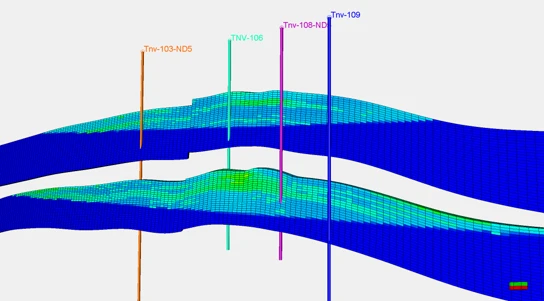
The dynamic model is one of the key tools for the development of the deposit and its further "life" over the coming years. It is a simulation that continuously shows what the deposit looks like so that it can be extracted as efficiently as possible.
It's a bit like weather forecasting: the more data you have and the less you look into the future, the more accurate the prediction. The only difference is that here you are forecasting thirty years ahead.
"It all starts with the geologist giving me interpreted data from 3D seismic, carottage and other sources, plus the results of laboratory analyses of cores and other input parameters," explains Milan Pagáč. Creating a model is a complex and responsible job. The dynamic model should answer a number of important questions: how much should the wells produce to keep them from becoming waterlogged? Is it worth adding more probes? If so, in which part of the deposit? How to adjust production over time to get the most out of the deposit?
These are questions that can be worth up to millions of dollars.
All the data is implemented in one model - first a static model, which is essentially a 3D image of the deposit, and later a dynamic model. The latter changes over time as mining progresses. And it gets progressively more precise as gas properties, water properties, quantities produced, pressures and so on are added - from pumping trials and subsequent production.
In early June, Milan Pagac created a dynamic model of the first two horizons out of eight at Tynivska. It is a very interesting deposit, with large reserves. These two horizons, ND4 and ND5, contain the most gas. Based on the modelling results, we will decide how many more wells to drill and where to place them.
"Here I can see the Tynivska 108 well - the red circles show me the actual daily gas production, the black circles show the static pressures and the yellow circles show the dynamic pressures - that is, what the pressures are at the bottom of the well when it is producing. The solid lines represent the values calculated by the simulator. My job is to adjust the model input parameters so that the calculated values are as close to the actual measured values as possible. Here we have a good match, which is perfect. When I have this data from all the probes that are on the deposit, it gives me a very good picture of what it looks like underground. Then I start making predictions, designs for new wells, and the simulator predicts how the deposit will behave even twenty years ahead. It will show how gas production will go, how pressures will drop, when the probes will water and so on," Milan shows various diagrams.
The simulation will also show an important indication of when the compressors will need to be switched on to draw gas from the wells and push it through to the expedition pipeline. This will allow much more to be extracted from the wells.
And, as Milan says, for horizons where there is gas and water, the dynamic model is much easier to build, the calculations don't take as long. In contrast, it takes weeks to do the simulation work for oil fields. But the outputs from the model then give detailed information on how to dewater the horizons, how many more wells to drill and in which parts, whether to drill horizontal wells, whether to inject water and other procedures to optimise production.

Editor-in-Chief
Other articles

MND Supports the School of Superheroes Project in Ukraine
MND is continuing its support for Ukraine through a second charity project in collaboration with Olena Zelenska’s foundation. Following the success of the first project, which helped dozens of foster families in Ukraine, the company has decided to support a unique initiative aimed at children in hospital.
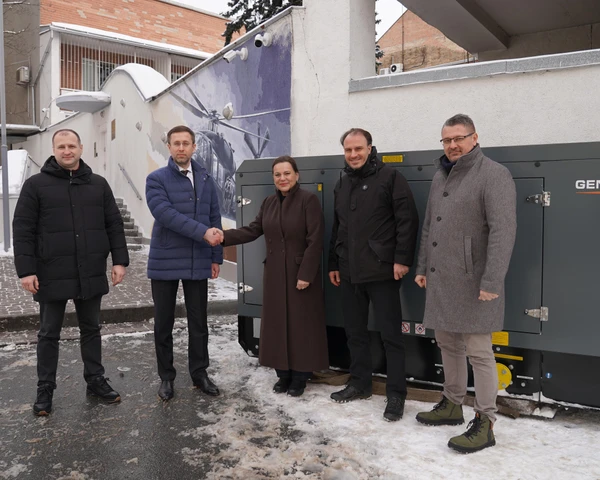
MND bought generators for Kiev for 11 million crowns
MND, a company that has been operating in Ukraine for many years, has purchased a total of ten electricity generators, costing eleven million crowns, for the residents of Kyiv. The generators vary in size – ranging from high-output units with a capacity of 140 kW, capable of supplying electricity to large apartment blocks, to smaller generators with an output of 13 kW designed for smaller buildings.
Disposal of Ždánice probes: closing another chapter of mining
At the start of 2023, the decommissioning of three wells in the Ždánice area was successfully completed. This symbolically marked the end of a chapter in the long history of oil and gas extraction in this region. Each well had a different history and significance, but what they had in common was that they had fulfilled their purpose and, upon reaching the end of their life cycle, were professionally and safely secured in a permanent state.