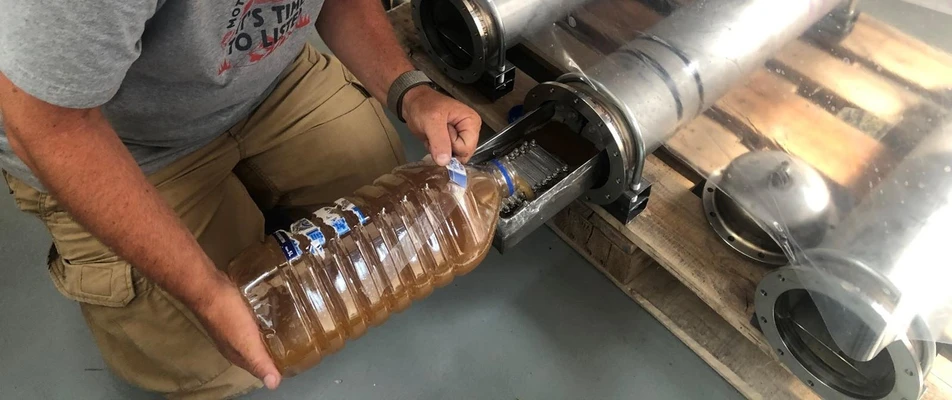
Testing the effect of hydrogen admixture on the technology in the storage tank
MND Energy Storage is participating in the joint project "The Effect Of Hydrogen In Mixture With Natural Gas In Underground Gas Storage Facilities On The Integrity Of Metallic Materials".
Objectives of the project
Hydrogen in particular is expected to play an increasing role in the energy mix in the coming decades as climate change mitigation measures are implemented. The Czech Republic is preparing to produce a hydrogen/natural gas mix and today's gas transmission system can handle up to a five per cent hydrogen/natural gas mix after replacing selected metering equipment. Transmission gas system operators must be able to accept up to a two percent blend of hydrogen in natural gas at border transfer points as early as this year.
Because underground gas storage facilities were designed and built primarily to store natural gas with trace or no hydrogen content, several technical issues that a natural gas-hydrogen blend could create in the technology will need to be analyzed. One of these is the resistance of existing materials to long-term contact with hydrogen or hydrogen mixtures.
MND Energy Storage, a. s. (MND ES) entered the materials testing project in 2022. In addition to MND, RWE Gas Storage (RWE GS) is also participating in the project, and the scientific part is provided by the Institute of Theoretical and Applied Mechanics of the Academy of Sciences of the Czech Republic (Institute of Theoretical and Applied Mechanics of the Academy of Sciences of the Czech Republic) and the University of Chemical Technology in Prague (VŠCHT). The total budget of the project is CZK 3.5 million and it should be completed at the end of this year. It is possible that other projects of a similar type will not be necessary to eliminate the negative effect of hydrogen on steel materials.
Progress of the project
Before embarking on this project, it was necessary to draw up an inventory of all pipe materials, apparatus and probe fittings, indicating the type of steel according to the material approvals, i.e. all steel components of the storage tank technology that may come into contact with hydrogen in the future. The inventory of materials lasted, intermittently, for about a year.
The assignment for the VŠCHT was divided into four parts:
- to carry out a detailed literature review on hydrogen, to gather information on gas storage tank materials and to carry out initial laboratory experiments.
- analyse solutions that may come into contact with steel surfaces, measure hydrogen permeation properties and the effect of hydrogen on the mechanical properties of selected grades of steel. The main objective of this part was to obtain the information needed for the design of long-term exposures at the partner institution of the Institute of Technical and Scientific Research of the CAS with respect to material selection and conditions.
- To systematically evaluate selected key parameters of hydrogen entry into steel, such as the effect of time and temperature on hydrogen entry into model mine water.
- to produce final reports of the different phases of the research
The tasks were then assigned to the ISTAM CAS, which were divided into five parts:
- design of autoclaves for long-term exposures, loading fixtures and procedures.
- experimental research on mechanical and fracture-mechanical properties of selected steel materials
- implementation of long-term exposures in autoclaves (half a year, one year)
- experimental research on mechanical and fracture-mechanical properties of selected steel materials used in gas storage technology
- comparison of results and preparation of final reports
On the basis of the evaluation of our steels and their characteristics, with the determination of the most susceptible steel type for hydrogen entry into the steel structure, carried out by the University of Science and Technology, we have provided a martensitic steel type with the designation 12022.1. This steel is used in our storage tank for a total length of 430 meters. The steel was used for laboratory tests to determine hydrogen entry into the steel during immersion in mine water from the Uhřice ZP technology. Mine water was taken from probes Uh 74, 75 and the inlet separator V 120. The results of the VCHT showed that our mine water increased the hydrogen entry into the steel and recommended to use this liquid also in the autoclave for long-term exposure in the Institute of Technical Sciences.
Experimental tests included a) static tensile tests, b) notch toughness tests, c) fatigue crack growth kinetics tests, and d) fracture toughness tests. A humid environment was chosen for the exposure (our aforementioned mine water was used), hydrogen pressure 50 bar with an exposure duration of one year. We plan to pull our samples out of the autoclave in July this year.
Project outputs
We now know the results of the experimental investigation of the mechanical and fracture-mechanical properties of three selected steel materials supplied by RWE GS. Reference tests were carried out in air, with the results being compared with those of samples subjected to long-term exposure (half a year) in compressed hydrogen while the test bodies were immersed in mine water supplied by RWE GS. The results were satisfactory and it was concluded that the hydrogen did not have much effect on these steels even after half a year and there was no deterioration in their properties. The same steel samples were tested in another autoclave (exposure of one year) and were extracted in April this year. Experimental tests are currently underway and the results will be presented shortly.
for Energy Storage
Eduard Matula and Pavel Marek
Other articles
Meeting with MND Energy Storage and MND Gas Storage customers
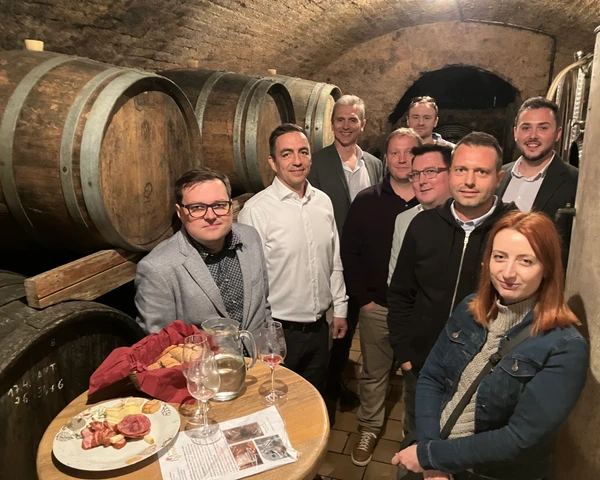
While the MND Party took place in Lužice on 13 June, the traditional customer meeting organised by MND Energy Storage and MND Gas Storage took place in Rakvice in the majestic Dominant Wine House. The event was attended by approximately 25 customers who came to find out what new products we are planning, as well as to enjoy delicious food and great wine.
MND aim to lead the way in hydrogen technology
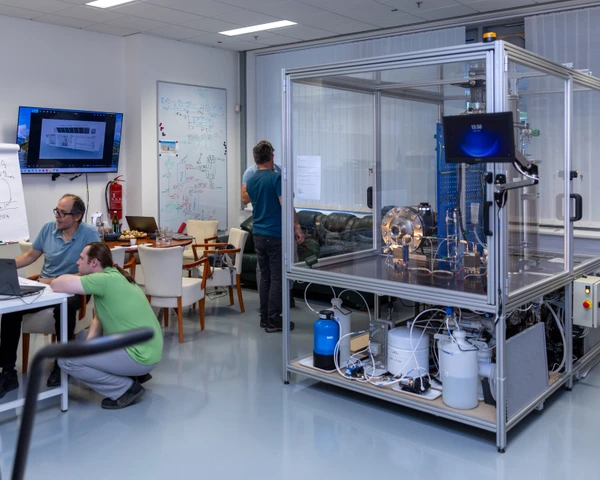
MND, a. s., Energy Division, has made a capital contribution to Nano Advanced, s. r. o. This is another significant step in the development of hydrogen technologies. MND was the first commercial producer of green hydrogen in the country, and MND Gas Storage is preparing for the possibility of storing a mixture of hydrogen and natural gas. Further hydrogen technology projects will require the acquisition of electrolyzers with power input up to 1 MW. Unfortunately, the delivery time for suitable electrolysers is three to five years due to the complexity of their production, and for this reason a capital entry into a company that would produce the equipment in priority for our company and adapt it to our needs seems to be a more interesting option.
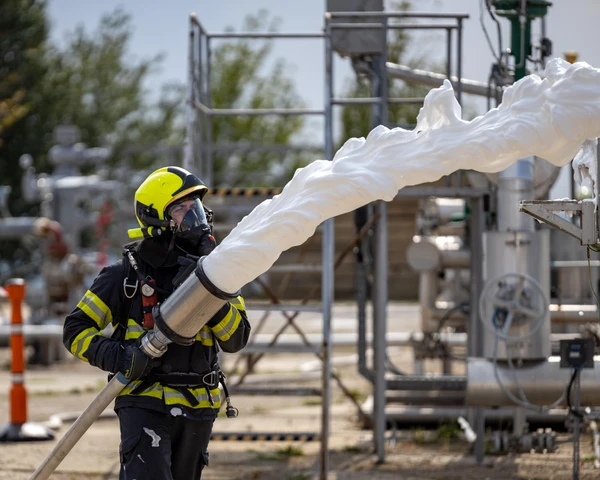
A hundred rescuers intervened at the reservoir in Uhřice. The exercise tested all components of the
"Section Commander to Strike Commander: we're starting to cool the probe!" comes over the radio from a fireman wearing a breathing mask. Streams of water from the fire hoses spray the production cross of the probe, from which gas escapes spontaneously to prevent ignition. Dozens of firefighters are on the scene, water tankers are running one after the other, an ambulance is on the scene and a drone is monitoring the situation.